
Semester Grade Calculator: Calculate GPA, Credits & Final Grades
Looking for a Free Semester Grade Calculator?
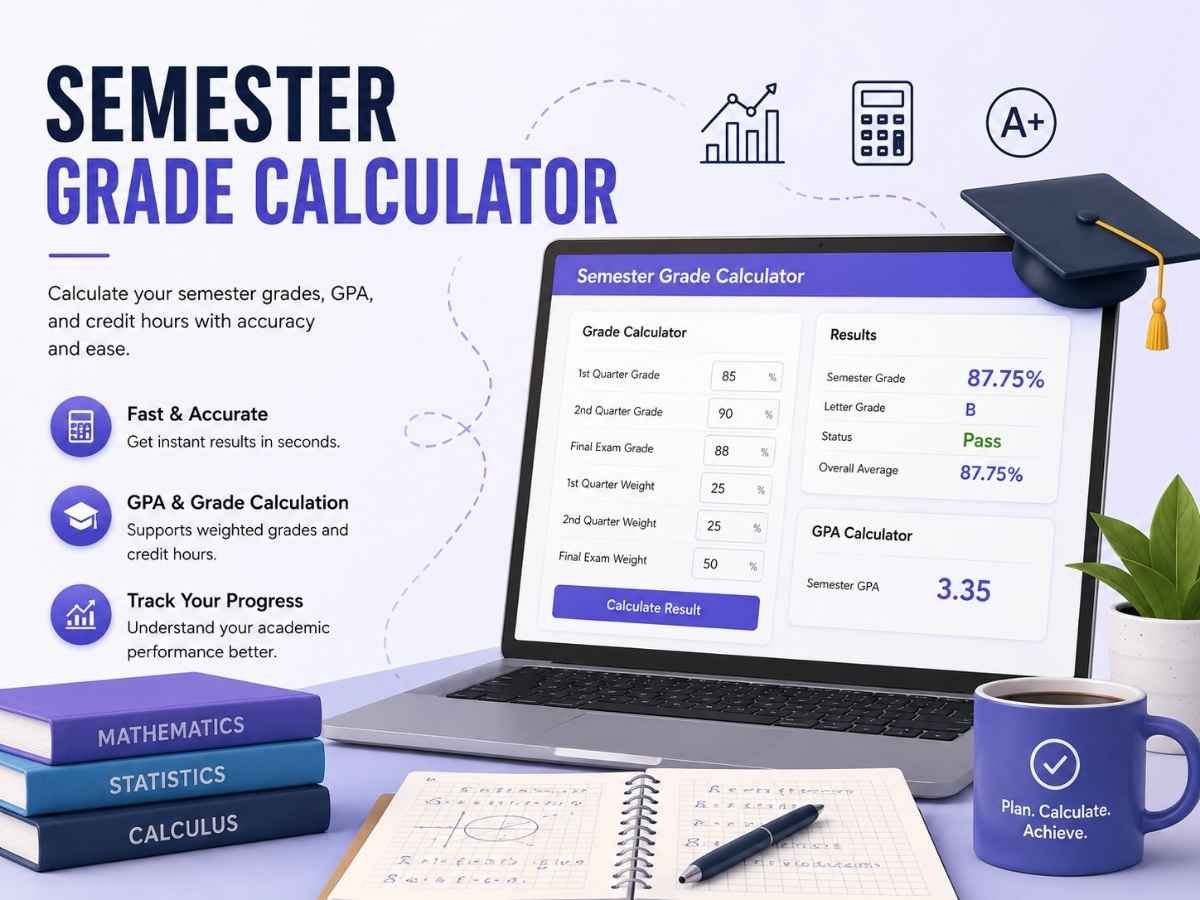
Our free Semester Grade Calculator helps you quickly calculate semester grades, GPA, credit hours, and weighted averages. Whether you’re a high school, college, or university student, this tool makes it easy to track academic performance and estimate final results in seconds.
Have questions or suggestions? Contact us through our support page—we’re always working to improve our calculators. support@semestergradecalculator.online
A semester grade calculator helps students estimate their final academic performance by combining assignment scores, exam results, credit hours, and weighted grades into a single outcome. Whether you are in high school, college, or university, understanding where you stand academically can remove uncertainty and help you make smarter decisions before the semester ends.
Many students struggle to predict their final results because grading systems often include multiple assessments, weighted exams, participation scores, and credit-based courses. A reliable grading tool simplifies this process, allowing you to track progress, identify risks early, and determine what scores you need to reach your academic goals. Instead of guessing, you can make data-driven decisions about studying, course selection, and GPA improvement.
Semester Grade Calculator: Calculate GPA, Credits & Final Grades
What is a Semester Grade Calculator?
A semester grade calculator is an academic tool that estimates a student’s overall performance for a specific semester. It combines grades from assignments, quizzes, projects, midterms, and final exams according to the grading weights assigned by a school or instructor.
Unlike a simple average calculator, this tool considers weighted grading systems and credit hours. This makes it especially useful for college and university students whose final outcomes depend on more than just test scores. By entering current grades and course information, students can quickly see where they stand academically.
Why Use a Semester Grade Calculator?
Students often face uncertainty about their academic standing until final grades are officially released. A grading calculator provides immediate insight into current performance and helps identify areas that need improvement before important deadlines arrive.
Another major advantage is planning. If you know your current grades and desired target score, you can determine exactly what performance is needed on upcoming exams or assignments. This allows for better study strategies and more realistic academic goal setting.
When Should You Use It?
This tool becomes valuable whenever you want a clear picture of your academic progress. Many students use it before midterms, before final exams, or during course registration periods when maintaining a certain GPA is important.
It is also useful after receiving major assignment grades. Instead of waiting until the end of the semester, students can regularly monitor their performance and make adjustments while there is still time to improve results.
Who Can Use This Tool?
High school students frequently use grade calculators to monitor semester averages and ensure they remain eligible for scholarships, athletic programs, or honor roll recognition. Teachers and parents may also use these calculations to help students stay on track academically.
College and university students benefit even more because their academic records often depend on credit-weighted GPA systems. Graduate students, transfer applicants, and scholarship candidates can also use the tool to evaluate their progress throughout the term.
How Does a Semester Grade Calculator Work?
The calculator uses weighted grading formulas to combine multiple academic components into a single result. Each assignment, project, quiz, exam, or participation score contributes a percentage toward the final semester grade.
Most tools allow users to enter grades along with corresponding weights. The calculator multiplies each score by its assigned percentage and combines the results to produce a final semester average. This process removes manual calculation errors and saves time.
Weighted Average Formula
Most academic institutions use weighted averages rather than simple averages. This approach recognizes that major assessments such as final exams carry greater importance than smaller assignments or quizzes.
The weighted average formula is:
Final Grade = (Score × Weight) + (Score × Weight) + …
For example:
| Assessment | Score | Weight |
|---|---|---|
| Assignments | 85 | 20% |
| Midterm | 88 | 30% |
| Final Exam | 92 | 50% |
Final Grade = (85 × 0.20) + (88 × 0.30) + (92 × 0.50)
This produces a more accurate representation of overall academic performance.
Understanding Credit Hours
Credit hours represent the academic value assigned to a course. A three-credit course usually has more influence on GPA calculations than a one-credit course because it requires more instructional time and academic commitment.
When calculating GPA, credit hours act as weighting factors. Courses with more credits contribute more heavily to the final GPA. This is why earning a high grade in a major course can significantly impact overall academic standing.
Graded vs. In-Progress Status
A graded course has received a final score and can be included directly in GPA calculations. These grades contribute officially to academic records and transcripts.
In-progress courses have not yet been completed. Students often use projected grades for these classes when estimating future results. While projections are useful for planning, they should not be considered official until final grades are posted.
The “Needed Average” Calculation
One of the most useful features of a semester grading tool is determining the average score needed to reach a target grade. Students frequently use this calculation before major exams or final projects.
For example, if a student currently has an 82% average and wants to finish with a 90%, the calculator can estimate the required score on remaining assessments. This information helps students focus their efforts and set realistic expectations.
How to Use This Calculator
Using the calculator is straightforward. Begin by entering each course grade, assignment score, or exam result. Next, enter the weight associated with each component if your institution uses weighted grading.
After entering all available information, the tool calculates your estimated semester result. Some calculators also provide GPA estimates, target grade calculations, and credit-weighted averages to support academic planning.
Example Calculation
Suppose a student receives the following grades:
| Component | Grade | Weight |
|---|---|---|
| Homework | 90% | 20% |
| Midterm | 85% | 30% |
| Final Exam | 88% | 50% |
Calculation:
(90 × 0.20) + (85 × 0.30) + (88 × 0.50)
Final Semester Grade = 87.5%
This result provides a realistic estimate of overall performance and helps students understand how individual assessments contribute to the final outcome.
Calculate your semester GPA by combining grades and credits from all your courses.
Semester GPA is calculated by assigning numerical values to letter grades and multiplying them by credit hours. Each course contributes grade points based on both academic performance and course weight.
For example, earning an A in a four-credit course has a larger impact than earning an A in a one-credit elective. GPA calculations therefore provide a broader measure of academic success than percentage-based grading alone.
Understanding Your Semester Grade
Your semester grade reflects overall academic performance across all assessments completed during a specific term. Depending on your institution, this may include homework, projects, quizzes, attendance, participation, midterms, and final examinations.
Understanding how each component contributes to the final result helps students make informed academic decisions. Instead of focusing only on exam scores, students can identify which areas offer the greatest opportunities for improvement and allocate study time more effectively.
How is the semester grade calculated?
Most schools and colleges use a weighted grading system where different assignments contribute varying percentages toward the final score. Major exams typically carry more weight than quizzes, homework, or participation grades.
The final semester grade is calculated by multiplying each score by its assigned weight and then combining the results. This approach provides a more accurate representation of performance than a simple average because it reflects the relative importance of each assessment.
| Component | Weight |
|---|---|
| Homework | 20% |
| Quizzes | 10% |
| Midterm Exam | 30% |
| Final Exam | 40% |
How do credit hours affect the final average?
Credit hours are especially important when calculating GPA. Courses with higher credit values contribute more significantly to the overall academic record because they represent greater instructional time and workload.
For example, earning an A in a four-credit science course generally impacts GPA more than earning an A in a one-credit elective. Understanding this relationship helps students prioritize courses that have the greatest influence on academic standing.
Why Your Semester GPA Matters
Semester GPA serves as one of the most important indicators of academic achievement. Many universities, scholarship programs, graduate schools, and employers review GPA when evaluating student performance.
A strong GPA may improve eligibility for scholarships, internships, academic honors, and competitive educational opportunities. Monitoring GPA throughout the semester allows students to make adjustments before final grades are recorded on their transcript.
Common Mid-Semester Scenarios
Many students use grade calculators after receiving midterm results. At this stage, they often want to know whether they are on track to achieve a desired grade or if additional effort is required before final exams.
Another common situation occurs when students are considering withdrawing from a course. By estimating potential outcomes, they can make more informed decisions about whether continuing or dropping a class is the better academic option.
Is Your Target Achievable?
Students frequently set academic goals such as earning an A in a course or maintaining a minimum GPA requirement. A calculator can help determine whether these targets remain realistic based on current performance.
If the required score on future assessments is extremely high, students may need to adjust expectations or focus additional effort on specific areas. Having clear numerical targets often reduces stress and improves planning.
Benefits for Students
One of the greatest benefits of using a semester grading tool is clarity. Students no longer need to rely on rough estimates or manual calculations that may contain errors.
These tools also encourage proactive academic management. Instead of reacting to poor results after the semester ends, students can identify potential issues early and take corrective action before grades become permanent.
Tips to Improve Your Semester GPA
Improving GPA begins with understanding how grades and credit hours affect academic outcomes. Students should prioritize assignments with higher weight percentages and focus on courses carrying more credits.
Consistent study habits, active class participation, regular review sessions, and timely assignment completion can significantly improve academic performance. Small improvements across multiple courses often produce a larger GPA increase than excelling in only one subject.
Common Mistakes to Avoid
One common mistake is assuming all assignments contribute equally to the final grade. In reality, final exams and major projects often carry substantially more weight than smaller coursework.
Another frequent error is ignoring in-progress courses when estimating future GPA. Students should regularly update calculations as new grades become available to maintain accurate projections throughout the semester.
Manual vs Calculator Method
Manual calculations can be effective for simple grading systems, but they become increasingly difficult when multiple weighted assessments and credit-based courses are involved.
A calculator automates the process, reduces mathematical errors, and provides immediate results. This allows students to spend less time calculating and more time focusing on academic improvement.
| Feature | Manual Calculation | Calculator |
|---|---|---|
| Speed | Slow | Instant |
| Accuracy | Depends on user | High |
| Handles Weights | Difficult | Easy |
| GPA Tracking | Time-consuming | Automatic |
| Multiple Courses | Complex | Simple |
Online vs Offline Calculation
Online calculators provide convenience, accessibility, and real-time updates. Students can quickly test different grading scenarios and evaluate multiple academic outcomes from any device.
Offline calculations may still be useful when internet access is unavailable, but they typically require more effort and increase the likelihood of errors. For most students, digital tools offer a more practical solution.
Is the Semester Grade Calculator Accurate?
A semester grade calculator is highly accurate when the correct grades, weights, and credit values are entered. Since the calculations are based on mathematical formulas, the results are generally reliable.
However, accuracy depends on the quality of the information provided. Estimated grades, missing assignments, or incorrect weights can affect the final projection. Students should always verify data before relying on calculated results.
When to Use This Semester GPA Calculator
A semester GPA calculator is particularly useful before registration periods, scholarship reviews, academic probation evaluations, and graduation planning. These situations often require students to understand their academic standing quickly.
It is also valuable when planning future coursework. Students can estimate how specific grades may affect cumulative GPA and determine whether additional effort is needed to meet academic objectives.
When to Use This Semester’s GPA Calculator vs. Other GPA Calculators
A semester GPA calculator focuses on a single academic term, making it ideal for monitoring current progress and planning short-term goals. It provides detailed insight into recent performance.
Other GPA calculators, such as cumulative GPA calculators, evaluate performance across multiple semesters. Students should use the appropriate tool depending on whether they are analyzing one semester or their entire academic history.
Frequently Asked Questions
Conclusion
Tracking academic progress should never feel complicated. By understanding weighted grades, credit hours, GPA calculations, and target score requirements, students can make better decisions throughout the semester. Whether you’re aiming for scholarship eligibility, maintaining academic standing, or simply planning ahead for final exams, a reliable semester grade calculator provides the clarity needed to stay on course and achieve your educational goals.
Start calculating now at SemesterGradeCalculator.online